10 Pairlists
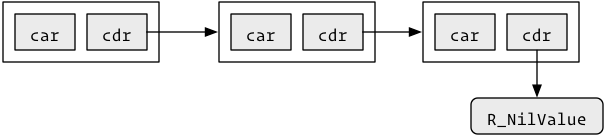
Pairlists (LISTSXP) are linked lists used for calls, unevaluated arguments, attributes, and .... The name comes from Lisp’s “dotted pairs”: each CONS cell is a pair of pointers:
CAR(contents of address register) points to the element.CDR(contents of decrement register) points to the next cell. TheCDRof the last cell isR_NilValue.
Graphically:
To loop over a pairlist, use this template:
int pairlist_length(SEXP x) {
  int i = 0;

  for (SEXP cons = x; cons != R_NilValue; cons = CDR(cons)) {
    SEXP el = CAR(cons);
    i++;
  }

  return i;
}
10.1 Test
10.1.1 Rf_isPairList(), Rf_isLanguage(), Rf_isList()
Header: Rinternals.h
Test whether an object is a pairlist, a call, or a pairlist-or-NULL.
Rboolean Rf_isPairList(SEXP x); // LISTSXP
Rboolean Rf_isLanguage(SEXP x); // LANGSXP
Rboolean Rf_isList(SEXP x);     // LISTSXP, NILSXP
Returns: TRUE when x passes the test — a pairlist for Rf_isPairList(), a call for Rf_isLanguage(), a pairlist or NULL for Rf_isList(); otherwise FALSE.
10.1.2 Rf_isUserBinop()
Header: Rinternals.h
Test whether a call is a user-defined binary operator.
Rboolean Rf_isUserBinop(SEXP);Returns: TRUE if x is a call to a user-defined binary operator (%...%), otherwise FALSE.
10.2 Creation
The CDR of the final cell must be R_NilValue; the Rf_list1()–Rf_list5() helpers add the terminator for you.
10.2.1 Rf_cons(), Rf_lcons()
needs protect throws
Header: Rinternals.h
Create a new CONS cell linking two objects.
SEXP Rf_cons(SEXP a, SEXP b);   // function arguments
SEXP Rf_lcons(SEXP a, SEXP b);  // calls
Returns: A freshly allocated cell with CAR set to a and CDR to b: a LISTSXP from Rf_cons(), a LANGSXP from Rf_lcons().
The CDR of the final value must be R_NilValue.
See also: Rf_list1(), Rf_lang1()
10.2.2 Rf_list1(), Rf_list2(), Rf_list3(), Rf_list4(), Rf_list5(), Rf_list6()
needs protect throws
Header: Rinternals.h
Create a pairlist of one to six elements.
SEXP Rf_list1(SEXP x1);
SEXP Rf_list2(SEXP x1, SEXP x2);
SEXP Rf_list3(SEXP x1, SEXP x2, SEXP x3);
SEXP Rf_list4(SEXP x1, SEXP x2, SEXP x3, SEXP x4);
SEXP Rf_list5(SEXP x1, SEXP x2, SEXP x3, SEXP x4, SEXP x5);
SEXP Rf_list6(SEXP x1, SEXP x2, SEXP x3, SEXP x4, SEXP x5, SEXP x6);
Returns: A freshly allocated pairlist of one to six elements, terminated by R_NilValue.
These automatically add the terminating R_NilValue.
See also: Rf_cons(), Rf_lang1()
10.2.3 Rf_lang1(), Rf_lang2(), Rf_lang3(), Rf_lang4(), Rf_lang5(), Rf_lang6()
needs protect throws
Header: Rinternals.h
Create a call to a function with zero to five arguments.
SEXP Rf_lang1(SEXP x1);
SEXP Rf_lang2(SEXP x1, SEXP x2);
SEXP Rf_lang3(SEXP x1, SEXP x2, SEXP x3);
SEXP Rf_lang4(SEXP x1, SEXP x2, SEXP x3, SEXP x4);
SEXP Rf_lang5(SEXP x1, SEXP x2, SEXP x3, SEXP x4, SEXP x5);
SEXP Rf_lang6(SEXP x1, SEXP x2, SEXP x3, SEXP x4, SEXP x5, SEXP x6);
Returns: A freshly allocated call (LANGSXP) to function x1 with the given arguments, terminated by R_NilValue.
These automatically add the terminating R_NilValue.
See also: Rf_cons(), Rf_list1()
10.2.4 Rf_allocFormalsList2(), Rf_allocFormalsList3(), Rf_allocFormalsList4(), Rf_allocFormalsList5(), Rf_allocFormalsList6()
needs protect throws
Header: Rinternals.h
Allocate a formals pairlist of two to six elements.
SEXP Rf_allocFormalsList2(SEXP x1, SEXP x2);
SEXP Rf_allocFormalsList3(SEXP x1, SEXP x2, SEXP x3);
SEXP Rf_allocFormalsList4(SEXP x1, SEXP x2, SEXP x3, SEXP x4);
SEXP Rf_allocFormalsList5(SEXP x1, SEXP x2, SEXP x3, SEXP x4, SEXP x5);
SEXP Rf_allocFormalsList6(SEXP x1, SEXP x2, SEXP x3, SEXP x4, SEXP x5, SEXP x6);
Returns: A freshly allocated formals pairlist of two to six elements, tagged with the given symbols.
These automatically add the terminating R_NilValue.
10.2.5 Rf_PairToVectorList(), Rf_VectorToPairList()
experimental needs protect throws
Header: Rinternals.h
Convert a pairlist to a list vector, or a list vector to a pairlist.
SEXP Rf_PairToVectorList(SEXP x);
SEXP Rf_VectorToPairList(SEXP x);
Returns: A freshly allocated copy of x converted to a list vector (Rf_PairToVectorList()) or a pairlist (Rf_VectorToPairList()).
10.2.6 Rf_listAppend()
experimental
Header: Rinternals.h
Append one pairlist to another.
SEXP Rf_listAppend(SEXP source, SEXP target);Returns: The mutated source pairlist, now with target appended; no new cells are allocated.
Mutates source in place by walking to its last cell and setting its CDR to target; no new cells are allocated and the returned pairlist is the (mutated) source you already hold.
10.2.7 Rf_allocLang()
needs protect throws
Header: Rinternals.h
Since: 4.4.1
Allocate a call (LANGSXP) with room for a function and n - 1 arguments.
SEXP Rf_allocLang(int n);n: total number of pairlist nodes (function plus arguments).
Returns: A freshly allocated call (LANGSXP) with n nodes, all elements initially R_NilValue.
The API replacement for the non-API idiom Rf_allocList(n) + SET_TYPEOF(..., LANGSXP). Fill in the function and arguments with SETCAR()/SETCADR() etc. before evaluating.
See also: Rf_lang1(), Rf_allocList()
10.2.8 CONS(), LCONS()
needs protect throws
Header: Rinternals.h
Prepend an element to a pairlist or call.
#define CONS(a, b)  Rf_cons((a), (b))
#define LCONS(a, b) Rf_lcons((a), (b))
Macro aliases for Rf_cons()/Rf_lcons(); the Rf_ forms are preferred in new code.
See also: Rf_cons(), Rf_lcons()
10.3 Accessors
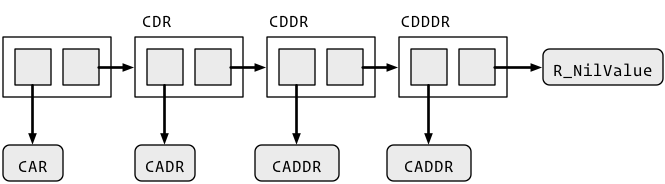
Unlike lists (VECSXP), pairlists can’t be indexed directly. Instead you navigate with CAR() (the first element) and CDR() (the rest of the list), composed into CAAR(), CADDR(), and so on, with matching setters SETCAR(), SETCDR(), etc.
10.3.1 CAR(), CDR(), CAAR(), CDAR(), CADR(), CDDR(), CDDDR(), CADDR(), CADDDR(), CAD4R(), CAD5R()
Header: Rinternals.h
Get the first element or a nested component of a CONS cell.
SEXP CAR(SEXP e);
SEXP CDR(SEXP e);
SEXP CAAR(SEXP e);
SEXP CDAR(SEXP e);
SEXP CADR(SEXP e);
SEXP CDDR(SEXP e);
SEXP CDDDR(SEXP e);
SEXP CADDR(SEXP e);
SEXP CADDDR(SEXP e);
SEXP CAD4R(SEXP e);
SEXP CAD5R(SEXP e);
Returns: The requested component of cell e — a pointer into the existing structure, not a copy.
Pairlists can’t be indexed directly, so these accessors navigate the linked list instead. CAR() returns the first element and CDR() the rest; they compose to give CAAR(), CDAR(), CADDR(), CADDDR(), and so on.
10.3.2 SETCAR(), SETCDR(), SETCADR(), SETCADDR(), SETCADDDR(), SETCAD4R()
Header: Rinternals.h
Set the first element or a nested component of a CONS cell.
SEXP SETCAR(SEXP x, SEXP y);
SEXP SETCDR(SEXP x, SEXP y);
SEXP SETCADR(SEXP x, SEXP y);
SEXP SETCADDR(SEXP x, SEXP y);
SEXP SETCADDDR(SEXP x, SEXP y);
SEXP SETCAD4R(SEXP e, SEXP y);
Returns: The assigned value y; the cell is modified in place.
Mirror the CAR()/CDR() family of getters.
10.3.3 TAG(), SET_TAG()
Header: Rinternals.h
Get or set the tag (name) attached to a node of a pairlist.
SEXP TAG(SEXP e);
void SET_TAG(SEXP x, SEXP y);
Returns: TAG() returns the tag (name) attached to node e, or R_NilValue if it has none.
See also: CAR()
10.3.4 MISSING()
Header: Rinternals.h
Test whether a pairlist element is a missing argument.
int MISSING(SEXP x);Returns: Non-zero if x is a missing argument, 0 otherwise.
SET_MISSING() was removed from the headers in R 4.6.0.
10.3.5 Pretending it’s a vector
A few functions let you treat a pairlist like a vector. These make it easy to write \(O(n^2)\) code, but pairlists are usually short enough that it doesn’t matter.
10.3.6 Rf_allocList()
needs protect throws
Header: Rinternals.h
Create a new pairlist of the specified length.
SEXP Rf_allocList(int n);Returns: A freshly allocated pairlist of length n with all elements R_NilValue.
Treats the pairlist as if it were a vector, which is easy to get O(n^2) from, but is unlikely to be a bottleneck at typical pairlist sizes. To create a call expression, use Rf_allocLang() (added in R 4.4.1) or Rf_lcons() rather than Rf_allocList() plus SET_TYPEOF(), which will not be available to packages in the future.
See also: Rf_nthcdr(), Rf_lcons()
10.3.7 Rf_nthcdr()
throws
Header: Rinternals.h
Access the nth element of a pairlist.
SEXP Rf_nthcdr(SEXP x, int n);Returns: The tail of x after n CDRs — a pointer into the existing pairlist, not a copy.
Treats the pairlist as if it were a vector; repeated calls can become O(n^2), though this is unlikely to matter at typical pairlist sizes. Errors if x is not a pairlist or has fewer than n elements.
See also: Rf_allocList(), CDR()
10.3.8 Rf_elt(), Rf_lastElt()
Header: Rinternals.h
Get an element of a pairlist by index, or the last element.
SEXP Rf_elt(SEXP, int);
SEXP Rf_lastElt(SEXP);
Returns: Rf_elt() returns the element of the pairlist at the given index and Rf_lastElt() the last element; both are pointers into the existing structure, not copies.
10.3.9 Creating a call
Pairlists are most commonly used to build function calls. Calls with 0 to 5 unnamed arguments can be created directly with Rf_lang1() to Rf_lang6(). For named arguments, build the call and set tags yourself:
// equivalent of: fun(arg1 = a, arg2 = b, arg3 = c)
SEXP call = PROTECT(Rf_allocVector(LANGSXP, 4)); // 4 = # of args + 1
SETCAR(call, fun);

SEXP s = CDR(call);
SETCAR(s, a);
SET_TAG(s, Rf_install("arg1"));

s = CDR(s);
SETCAR(s, b);
SET_TAG(s, Rf_install("arg2"));

s = CDR(s);
SETCAR(s, c);
SET_TAG(s, Rf_install("arg3"));

SEXP out = PROTECT(Rf_eval(call, env));
...
UNPROTECT(2);
10.4 Dots (DOTSXP)
DOTSXP represents the ... structure inside a function. Retrieve it with Rf_findVar(R_DotsSymbol, env) or similar. It’s usually a pairlist, but is R_MissingArg when there are no ... arguments.
10.5 Null (NILSXP)
There is a single value of type NILSXP: R_NilValue. It corresponds to NULL in R and is often used as a generic zero-length vector — and as the terminator of every pairlist.